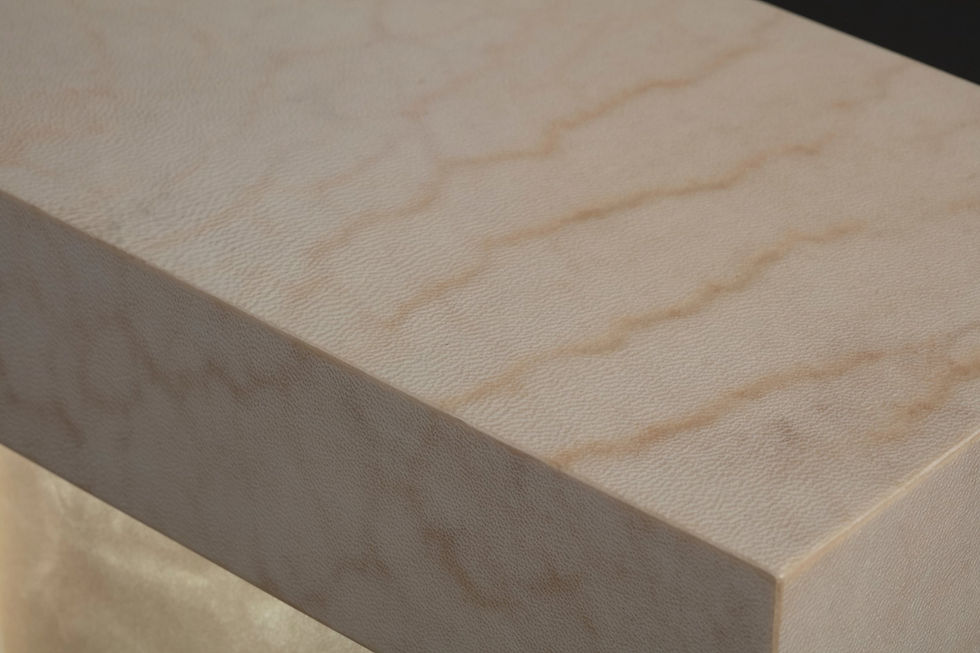
FAUX BOIS AND STRIÉ: HISTORIC TECHNIQUES REIMAGINED TO ENRICH MODERN SPACES

Faux finishes have historically balanced replication and creative expression, and are now finding themselves firmly back in the design spotlight. Among them, faux painted wood (faux bois) is having a particularly strong moment in interiors this year, showing up in everything from tailored city apartments to elegant country homes from the Hamptons to the Bahamas. Its warmth and texture draws us in, and when paired with softer, more atmospheric techniques like strié, spaces feel layered without being heavy-handed. What’s notable about this resurgence is not nostalgia for the ornate past, but a renewed respect for craftsmanship and surface as a central element of design.
The appeal of faux finishes has never been simply about imitation. Historically, they were born out of necessity—an efficient way to evoke rare or expensive materials when the real thing was impractical. But that origin story only explains part of their endurance. Today, when engineered wood and printed laminates can replicate almost anything at scale, faux bois persists because it offers something those materials cannot: the human touch. The slight irregularity in a painted grain, the softness of a dragged glaze, the way light catches a hand-worked surface—these are qualities that set this artistry apart.
“What draws me to faux bois and strié is what draws me to craft itself; you can feel the hand of the artisan behind it. Sylvie, Sopiko, and Tim bring something to a surface that no process can manufacture, a quality that makes a room feel genuinely alive.” —SuperStrata founder Jonas Everets


1. Faux painted wood wainscotting by David Faust.
2. Faux ripple walnut light switch by Sopiko Barnovi.
Faux bois doesn’t just copy wood, but interprets it. The role of the artisan is central here because a skilled decorative painter studies the anatomy of the wood and the uniqueness of each wood species—the way grain bends around knots, the subtle shifts in tone, the rhythm of lines that never quite repeat—and then reconstructs it through layers of paint and glaze.
The process is both controlled and improvisational. A base coat establishes the underlying tone, often lighter than the intended finish. Over that, translucent glazes are manipulated with brushes and combs, pulled and softened until something resembling natural growth begins to emerge.


1. Faux painted wood wall by Sylvie Bilger with SuperStrata.
2. Closeup of faux painted wood by Sopiko Barnovi.
Our artisans hone their skills over years of dedicated practice, with some artisans training at institutions devoted to this craft, such as the Van Der Kelen Logelain school of decorative painting in Brussels. SuperStrata’s Sylvie Bilger trained there before taking her expertise in faux and decorative finishes to residences around the world and even the Château de Versailles.


1. Faux painted flame mahogany wood sample by Sylvie Bilger as part of her training at Van der Kelen Logelain. Photo by Nick Glimenakis.
2. Faux painted wood panel by Sylvie Bilger with SuperStrata.
Running parallel to this renewed interest in wood graining is a quieter appreciation for strié, a painting technique that operates in a different way than faux bois. It doesn’t try to replicate a specific material so much as evoke a feeling—softness, with movement—and create an effect that is understated yet visually enriching. Created by dragging a dry brush through a layer of glaze, it leaves behind fine linear traces that can read as fabric such as linen, or more simply, texture. A flat wall begins to hold light differently; it gains depth without an obvious pattern.


1. Strié decorative painting on the millwork by SuperStrata for Carrier & Company. Photo by Thomas Loof.
2. Hand-painted strié wall by Tim Murphy and Sopiko Barnovi.
"The New Drawing Room" in the 2025 Kips Bay Decorator Show House is an example of incorporating both faux bois and strié techniques for a fresh take on the more historic wood paneled room. SuperStrata artisan Sopiko Barnovi collaborated with designer Alessandra Branca of Branca Interiors to paint dragged faux bois on the crown mouldings and baseboards, as well as a strié bookcase and window frames.


1. Strié bookcase and doors, faux bois crown mouldings by Sopiko Barnovi with SuperStrata in the Kips Bay Show House 2025 for Branca Interiors.
2. Details of strié bookcase by Sopiko Barnovi with SuperStrata in the Kips Bay Show House 2025 for Branca Interiors.


1. Details of dragged faux bois crown mouldings and entrance frame by Sopiko Barnovi with SuperStrata in the Kips Bay Show House 2025 for Branca Interiors. 2. Dragged faux bois crown mouldings and strié window casings by Sopiko Barnovi with SuperStrata, in the Kips Bay Show House 2025 for Branca Interiors.
Strié doesn't have to be so subtle, either: Our artisan David Faust combined the technique with a vivid emerald green color throughout the library of a historic house in Brooklyn Heights, resulting in a space that is both restorative and energizing.

Faux bois can be done in a marquetry style to show several different wood types, each with their own unique charm. Tim Murphy especially adept at this, using his expertise and trained eye to flawlessly paint birds eye maple and satinwood side by side to great effect.


1. Faux painted birds eye maple and satinwood marquetry by Tim Murphy.
2. Faux chestnut and walnut burl wood marquetry wall by Tim Murphy.
In a similar vein, Sopiko created an eye-catching dragged wood diamond design with rich, warm tones to feature faux bois as more of a geometric pattern for wallpaper.

Rooted in historic technique yet tailored for today, faux bois and strié add richness, movement, and nuance that only hand-applied finishes can achieve. Our talented artisans combine deep experience with a passion for their craft. Collaborate with SuperStrata to create surfaces that are as distinctive as they are timeless.