
SCAGLIOLA: A HISTORIC ART FORM CAPABLE OF TRANSFORMING DESIGN
Updated: Feb 10

"There is a kind of alchemy in coaxing raw earth and pigment into something luminous, enduring, and alive—each pattern I create holds its own mystery and magic."
—SuperStrata artisan Melissa Vogley Woods
The art of scagliola (pronounced "skal-yoh-luh”) combines gypsum, lime, glue, and raw pigments to create a material that mimics the patterns and complexity of marble and stone inlay in both fine sculptural and architectural elements. It is a rare art form, and per our artisan Melissa Vogley Woods, "Scagliola holds the painter’s joy of composition and color as well as the sculptor’s devotion to form, texture, and touch."


Details of large-scale scagliola sculptures in Atrium National Bank designed by Beth Stuart and fabricated by Melissa Vogley Woods.
Scagliola dates back to the late 16th century in Europe, showing the most production in the northern part of Italy. It was initially used in churches, palaces, and within the homes of society's upper echelon. Scagliola saw its prime throughout Europe for the next three hundred years, and is now seeing a resurgence of popularity in recent years.
AMERICAN (MAREZZO) AND ITALIAN STYLES
American style scagliola—known as Marezzo—is mainly used for architectural features and is always produced using a mold. On the other hand, the classical style of Italian scagliola is more nuanced and features marble-like veining to imitate real stone. This can be surface applied and does not need to be produced in a mold. Regarded as the most sophisticated form of scagliola, the Italian style allows for the development of intricate and highly detailed designs.


1. Marezzo style scagliola detail in a courthouse in Iowa, USA, repaired by Melissa Vogley Woods.
2. Marezzo style scagliola columns in a courthouse in Iowa, USA, repaired by Melissa Vogley Woods.


1. Italian scagliola example in Emilia-Romagna, Italy.
2. Details of Italian scagliola example in Emilia-Romagna, Italy.

PAINTERLY TECHNIQUE
The painterly technique diverges from the Italian style to use the art form as a medium for painting. It instead emphasizes color, form, and composition, allowing even more artistic expression and possibility.


1. Scagliola example imitating marble in Emilia-Romagna, Italy.
2. Details of scagliola example imitating marble in Emilia-Romagna, Italy.


1. Scagliola using a painterly technique, designed and fabricated by Melissa Vogley Woods.
2. Scagliola using a painterly technique in the Basilica Cattedrale di Santa Maria Assunta of Capri, Italy.
INLAY AND SGRAFFITO TECHNIQUES
To fill carved designs, Scagliola inlay is used to create decorative patterns that resemble marble marquetry. The sgraffito technique appears like a drawing through the use of etching into the scagliola surface, and can be combined with inlay to add fine lines and delicate details.
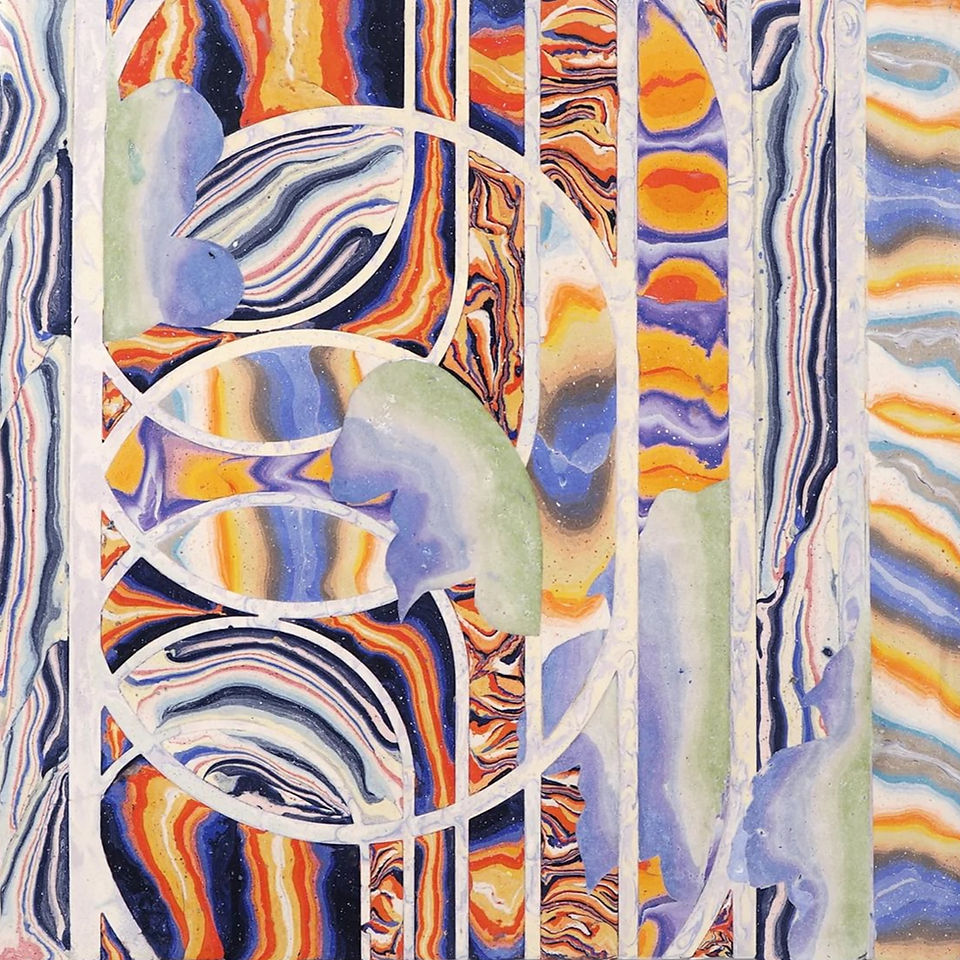

1. Scagliola inlay piece designed and fabricated by Melissa Vogley Woods.
2. An example of sgraffito scagliola style, as seen in the Museo della Città of Capri, Italy.
As seen in Melissa Vogley Woods’ scagliola works below, these richly patterned surfaces can elevate designs and transform everything from furniture and fine art sculptures to architectural elements such as columns and fireplace surrounds.


1. Stacked scagliola side table designed and fabricated by Melissa Vogley Woods.
2. Medium sized scagliola knot sculpture designed and fabricated by Melissa Vogley Woods.


1. Free form scagliola with metal mesh, burlap, and fiberglass that can be used for furniture or more dimensional sculptural works of art, designed and fabricated by Melissa Vogley Woods.
2. Interlocking scagliola wall forms designed and fabricated by Melissa Vogley Woods.
Our artisan Melissa Vogley Woods is a master of scagliola, drawing inspiration from architectural forms and botanical shapes to guide both the structure and composition of her artistry. She designs and fabricates fine art and fantastical shapes to wall art and seating forms, and especially excels in large-scale installations with multiple elements.
BEHIND THE SCENES OF THE SCAGLIOLA PROCESS
Below, Melissa demonstrates different parts of the scagliola process, featuring scagliola inlay as well as a fantastical scagliola design done in the Italian style. She mixes a range of pigments into a dough-like scagliola loaf, cuts the wet loaf to then be pressed into a mold or onto a surface. Then once the pieces cure, they are sanded down and connected to a steel core and fiberglass is used for reinforcement before wax is applied as the final touch.


1. Melissa Vogley Woods mixes a range of pigments into the scagliola composite (a blend of gypsum plaster, lime, glue) into a dough-like consistency that will make up a “loaf.” The colors are often very similar when wet, but once cured the color reveals itself, becoming richer and brighter.
2. Melissa Vogley Woods cutting the “loaf” of wet scagliola. This is the soft scagliola before it is cured and becomes hardened (a chemical process it undergoes that stabilizes the materials). The loaf contains a range of colors that make up the overall design of the scagliola pattern.


1. Using the cut pieces of the loaf, the scagliola is pressed into the mold by hand. The Marezzo style involves pouring the liquid contents into the mold. The molds need to be open and accessible to the process, as the artisan would need to fit their hands into it.
2. The molded scagliola pieces are connected to the steel core from the inside.


1. The inside of the scagliola is reinforced with burlap and fiberglass that is also used to attach it to the steel core.
2. Melissa Vogley Woods sands scagliola inlay to lay flush. The level of shine comes from the amount of sanding grit: A matte finish is 800 grit, while full shine is 3000 grit. The final step is applying Renaissance Wax to seal the scagliola.

Scagliola was traditionally applied directly to walls, and it can be surface applied on the proper substrate or prepared wall. Different scagliola styles can be integrated seamlessly, as the material bonds to itself—most notably in inlay scagliola. Fibrous materials such as fiberglass and burlap are incorporated to reinforce this bond at a structural level, which is particularly critical for large-scale installations.

Scagliola can be made in studio and shipped worldwide for installation by others, or made on site to be attached to the surrounding architecture. The artistry of scagliola is uniquely versatile, offering distinctive applications that elevate and transform interiors.
At SuperStrata, we pair this with a wide range of artisan techniques, giving you the ability to tap into our deep pool of knowledge when it comes to exceptionally crafted finishes and artisan design.


